What is AuDHD? A plain English guide for adults
What people mean by AuDHD: co-occurring autistic and ADHD trait patterns, how they tend to show up in adults, and what reflection can and cannot tell you.
AuDHD is informal community shorthand for co-occurring ADHD and autism. It is not a separate diagnosis. Some people also use it while exploring both sets of trait descriptions, but relating to descriptions does not establish either condition. This guide explains the term and the limits of self reflection.
Plain English summary
What is AuDHD? A plain English guide for adults
AuDHD is informal community shorthand for co-occurring ADHD and autism. It is not a separate diagnosis. Some people also use it while exploring both sets of trait descriptions, but relating to descriptions does not establish either condition. This guide explains the term and the limits of self reflection.
What this can help with
Naming examples, comparing patterns, and preparing notes for your own reflection or a professional conversation.
What this cannot do
Confirm, diagnose, rule out, or replace assessment by a qualified professional.
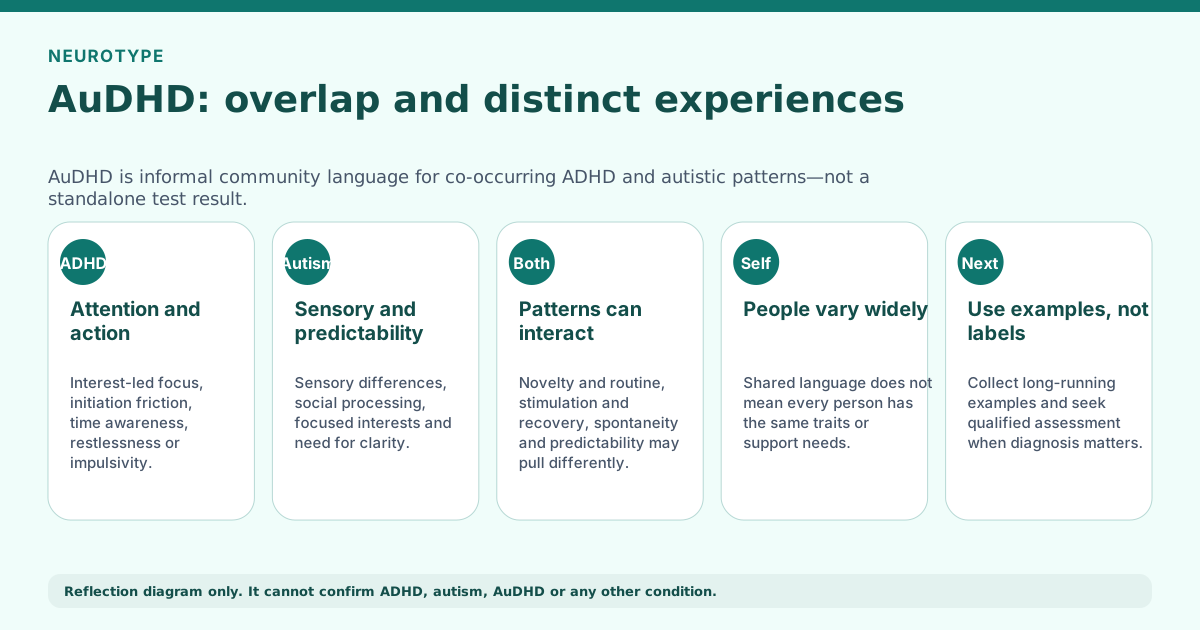
The diagram separates ADHD-like attention and action patterns from autistic sensory, social-processing and predictability patterns, then shows how they may interact while emphasising individual variation and qualified assessment.
How to use this page
- Use the wording to name examples from your own adult life.
- Keep what fits and ignore what does not fit your situation.
- Treat this as reflection material, not diagnosis, treatment advice, or proof of any condition.
Try a related checker
AuDHD pattern map
A calm self reflection map for adults exploring co-occurring traits.
Open the reflection toolWhere the term comes from
AuDHD is a community term rather than a separate clinical category. DSM-5 removed the earlier exclusion that prevented concurrent autism and ADHD diagnoses, and current evidence and guidance recognise that the conditions can co-occur. A qualified clinician still assesses each condition against its own criteria.
People use AuDHD in different ways, including as shorthand for two diagnoses or while exploring both descriptions. The word itself cannot confirm either condition.
- It is shorthand for co-occurring ADHD and autistic trait patterns.
- It is used by adults to describe themselves, not as a formal diagnosis.
- DSM-5, published in 2013, allowed concurrent diagnoses under its framework.
Patterns adults commonly describe
People may describe combinations such as wanting predictability while also seeking novelty, becoming absorbed in some activities while struggling to begin others, or wanting connection while finding some interactions tiring. These examples are not unique to co-occurring ADHD and autism and are not a diagnostic checklist.
A clinician considers the full ADHD and autism criteria, developmental history, functioning, and other possible explanations rather than treating an apparent contradiction as proof of AuDHD.
AuDHD describes the place where two trait patterns meet inside one person, not a diagnosis you receive.
What reflection can and cannot tell you
Reading about trait patterns can help you put words around lived experiences. It can also help you notice patterns you had not connected before. Reflection cannot tell you whether you meet diagnostic criteria for ADHD, autism, or any other condition. Only a qualified clinician can do that, and only with context that no online resource has.
If reading material like this makes your experience feel more recognisable rather than more confusing, that is meaningful. It is not the same as a diagnosis, and it does not need to be.
Useful next steps
If you want to explore the AuDHD framing further, start small. Read a few first person accounts from adults rather than only diagnostic checklists. Pay attention to how your day actually goes rather than how you think it should go. Note the situations that drain you and the ones that recharge you. Notice which descriptions sound like your own voice and which sound like someone else.
If the patterns are affecting daily life in ways that feel hard, speaking with a clinician who understands both ADHD and autism in adults is the most reliable next step. They can hold the full picture rather than only one half of it.
AuDHD traits in adults: the patterns people most often describe
Adults who use AuDHD language report varied combinations of attention, routine, sensory, and social experiences. This guide offers non-specific reflection examples. It is not a checklist and cannot show whether ADHD, autism, or both apply.
Two shapes of attention that live in the same person. ADHD and autism descriptions can both include attention or task-switching differences, but the constructs and evidence are more complex than a novelty-versus-depth rule. A person might become absorbed in one activity and struggle to begin another for many reasons. That contrast cannot identify either condition or explain its mechanism.
Social energy that runs in two directions. Some people describe wanting social connection while also feeling tired after interaction. That experience is not specific to ADHD, autism, or their co-occurrence. Duration, setting, sleep, anxiety, depression, physical health, sensory conditions, and the demands of the interaction may all matter. Camouflaging has cross-sectional and qualitative associations with distress and exhaustion in some samples, but those studies do not prove it caused one person's fatigue.
Routine and novelty, both wanted. A preference for predictability can coexist with interest in novelty, but this is not unique to AuDHD and does not map cleanly onto one condition per side. Record when each preference appears, what function it serves, and whether it causes impairment rather than assuming a diagnostic mechanism.
The useful question is what the pattern looks like today, not which label wins.
Sensory and emotional intensity. Sensory differences are included in autism criteria and have also been reported in some ADHD studies, while emotional-regulation difficulty is studied as an associated ADHD feature. Neither is universal or specific, and a subjective sense of intensity does not show that a nervous system is taking in more information. New or significant sensory, emotional, or interoceptive changes may need medical or psychological assessment.
- Being chatty and outgoing in some settings, depleted afterwards.
- Wanting friendships and finding the upkeep heavy.
- Going home from a fun evening and needing the rest of the night quiet.
Read next on AuDHD patterns
These pages stay in the same area, but they come at it from different angles: a question, a comparison, or an everyday example.
AuDHD in adults
The main NeuroType overview of overlapping ADHD and autistic trait patterns.
ADHD and autism in adults: how the patterns compare
A side by side comparison of where the descriptions overlap and where they differ.
Am I autistic, ADHD, or both?
How self reflection can help when both descriptions feel partly true.
Executive function in everyday life
A related pillar for task initiation, planning, and attention switching.
Autism masking explained
A related pillar for social effort, performance, and recovery.
Sensory overload in adults
A related pillar for sensory load and environmental friction.
Reflection prompts
- Which parts of the ADHD description sound like your everyday life, and which do not?
- Which parts of the autism description sound like your everyday life, and which do not?
- Are there contradictions in your patterns that one label alone has never explained?
- When you read about AuDHD specifically, does anything feel more recognisable than it did before?
- Where in your life do you notice both shapes of attention living together?
- What does social recovery look like for you, and when do you most need it?
- When you imagine an ideal week, where does routine help and where does novelty help?
- Which sensory or emotional experiences in your life feel more intense than other people seem to expect?
Questions readers ask
- Is AuDHD a real diagnosis?
- AuDHD is not a separate diagnosis. It is informal shorthand for co-occurring ADHD and autism, although some people also use it while exploring both descriptions. A clinician assesses each condition separately; the word itself confirms neither.
- Can ADHD and autism really co-occur?
- Yes. ADHD and autism can be diagnosed in the same person. Studies report co-occurrence, but estimates vary by age, sample, definitions, and method and should not be used to estimate one individual's likelihood.
- How is AuDHD different from just ADHD or just autism?
- AuDHD is shorthand for co-occurrence, not a third condition with its own validated criteria. A person may experience interacting needs or symptoms, but examples such as intense focus, fatigue, or wanting both routine and novelty are non-specific.
- Should I get assessed?
- That is a personal decision. Some adults find that formal assessment opens up support, accommodation, or self acceptance. Others find that informed self reflection is enough for them. If patterns are affecting work, relationships, or wellbeing in ways that feel hard, a clinician familiar with adult ADHD and autism is the right next step.
- Are these traits the same as symptoms?
- Traits are descriptions of patterns. Symptoms are clinical signs that a professional may use as part of a diagnosis. NeuroType uses trait language because it does not diagnose anything.
- I relate to some but not all of these. What does that mean?
- It means you are a person with your own pattern. Lists like this are prompts, not portraits. Notice which patterns sound like you and which do not.
- Can I have these patterns without having AuDHD?
- Yes. These patterns can show up in many people for many reasons including stress, burnout, hormonal change, sleep, trauma, or context. A pattern is information. It is not a label.
Was this page helpful?
Related exploration
Continue reading
Adult neurodivergent guides
Autism masking explained, without the jargon
What people mean by masking, why adults often only notice it later, and how the recovery cost can quietly shape a day.
Compare overlapping patterns
ADHD and autism in adults: how the patterns compare
Where adult ADHD and autistic trait descriptions overlap, where they differ, and why both can be present together.
Common self reflection questions
Am I autistic, ADHD, or both? What self reflection can help with
Why this question is hard to self assess, why the traits overlap, and how to organise your thoughts before a professional conversation.
Adult neurodivergent guides
Executive function in everyday life
What executive function actually means in a working week, where it shows up most, and why the easy task is so often the hardest one to start.
Sources and limits
Last updated: 2026-08-07. Editorial status: approved.
Approved means NeuroType editorial approval. It does not mean this page was reviewed by a clinician, lawyer, tax professional, or welfare-rights adviser.
NeuroType pages are written for adult self reflection and education. Sources, when listed, are there so readers can check the background material. Inclusion does not imply endorsement, clinical review, or diagnostic authority.
- 1.Autism Spectrum Disorders and ADHD: Overlapping Phenomenology, Diagnostic Issues, and Treatment Considerations, Antshel & Russo, Current Psychiatry Reports (2019) link
- 2.Psychiatric and psychosocial problems in adults with normal-intelligence autism spectrum disorders, Hofvander et al., BMC Psychiatry (2009) link
- 3.Shared heritability of ADHD and autism spectrum disorder, Rommelse et al., European Child & Adolescent Psychiatry (2010) link
- 4.Emotion dysregulation in attention deficit hyperactivity disorder, Shaw et al., American Journal of Psychiatry (2014) link