Reflection guide10 min read
ADHD DSM-5-TR criteria for adults
Plain English guide to adult ADHD criteria: symptom counts, presentations, onset, settings, impairment, and why self reflection cannot replace a clinician.
Review status
Founder reviewedReviewed by the NeuroType founder for tone, scope, and safety language. Not a substitute for legal or clinical review.
- Scope:
- Plain-English explainer of the DSM-5-TR framework structure for ADHD, with ICD-11 comparison.
- Last reviewed:
- 2026-06-01
- Limitations:
- Founder review only. Not clinically reviewed. Describes framework structure, not diagnostic criteria text.
Short answer
ADHD DSM-5-TR criteria for adults
The DSM-5-TR is the manual most clinicians in the United States and many other places use to frame ADHD. It organises ADHD around two groups of patterns, inattention and hyperactivity-impulsivity, and sets conditions about how many patterns are present, how long they have lasted, when they began, how many settings they affect, and how much they interfere with daily life. This page explains that structure in plain English. It does not reproduce the manual's wording, it cannot diagnose you, and it is not a substitute for a professional assessment.
What this can help with
Naming examples, understanding common language, and preparing notes for reflection or a professional conversation.
What this cannot do
Confirm, diagnose, rule out, or replace assessment by a qualified professional.
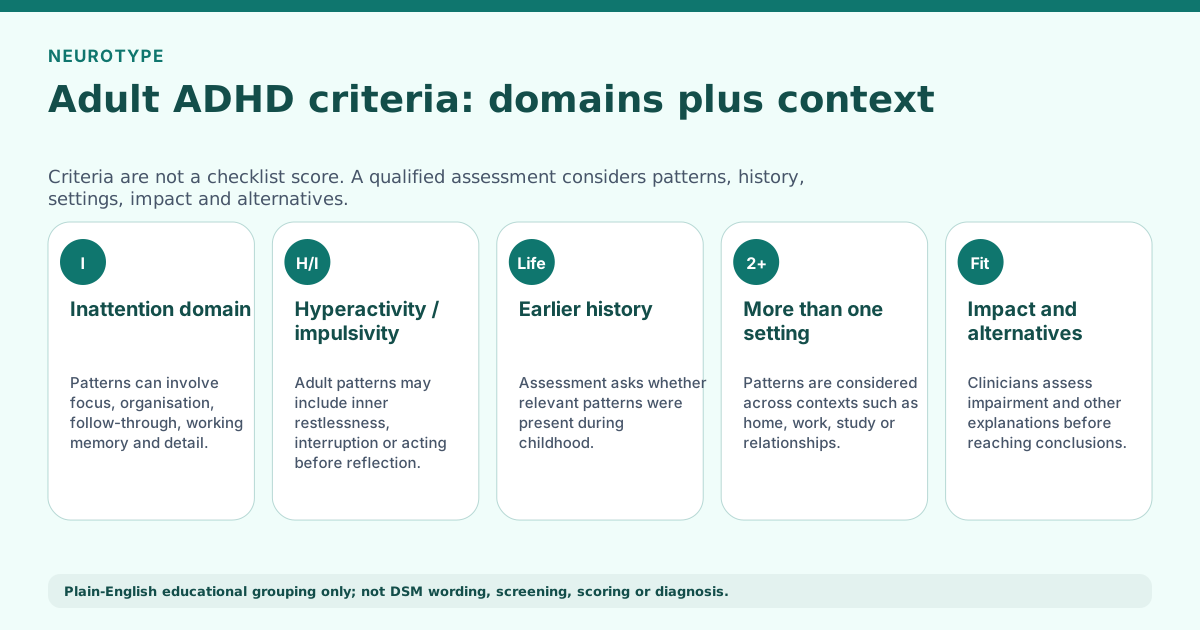
The diagram groups plain-English inattention and hyperactivity or impulsivity domains with childhood history, multiple settings, impact and alternative explanations. It does not reproduce DSM wording or provide screening or scoring.
Related NeuroType path
Begin the guided journey
Work through the reflections in one guided route. It ends in a combined summary you can keep for a conversation with a qualified professional.
Open related pathFree, no account needed. Not a diagnosis.
Short answer
The DSM-5-TR is the manual most clinicians in the United States and many other places use to frame ADHD. It organises ADHD around two groups of patterns, inattention and hyperactivity-impulsivity, and sets conditions about how many patterns are present, how long they have lasted, when they began, how many settings they affect, and how much they interfere with daily life. This page explains that structure in plain English. It does not reproduce the manual's wording, it cannot diagnose you, and it is not a substitute for a professional assessment.
The two groups of patterns
The DSM-5-TR describes ADHD using two domains. The first is inattention, which covers patterns like difficulty sustaining focus, being easily distracted, losing things, forgetfulness in daily activities, and struggling to organise tasks. The second is hyperactivity and impulsivity, which covers patterns like restlessness, difficulty staying seated or settled, acting or speaking before thinking, and impatience.
In each domain there is a set of described patterns. A clinician considers how many of them are present and persistent. For adults, the threshold is set lower than for children, in recognition that the way these patterns show up tends to change with age.
The conditions beyond a checklist
A diagnosis is never just counting patterns. The DSM-5-TR framework adds several conditions that matter as much as the lists.
Onset: several patterns need to have been present earlier in life rather than appearing only recently. Settings: the patterns need to show up in more than one part of life, such as work and home, not just one. Interference: the patterns need to genuinely affect or reduce the quality of daily functioning. And other explanations: the difficulties should not be better accounted for by another condition or by circumstances. These conditions are why a quick quiz cannot stand in for an assessment.
Presentations and severity
The framework also describes different presentations depending on which domain is more prominent: a mainly inattentive presentation, a mainly hyperactive-impulsive presentation, and a combined presentation. These are not fixed types. A person's presentation can change over time and across situations.
Severity is described as mild, moderate, or severe, based on how many patterns are present beyond the threshold and how much they affect daily life. For more on the inattentive picture specifically, see inattentive ADHD in adults.
How DSM-5-TR differs from ICD-11
The DSM-5-TR is published by the American Psychiatric Association. The ICD-11 is published by the World Health Organization and includes clinical descriptions and diagnostic requirements for ADHD. They are separate classification systems with differences in wording and structure. Which system and national guidance apply depends on the jurisdiction and service, so check current local guidance rather than assuming one universal process. Neither framework turns a self-test into a diagnosis.
Adult thresholds: symptom counts, timing, and settings
For adults aged 17 and older, the DSM-5-TR asks for five or more inattention symptoms and/or five or more hyperactivity-impulsivity symptoms. Children need six or more. The symptoms need to have been present for at least six months, be inconsistent with the person's developmental level, and have a meaningful impact on social, academic, or occupational function. Several must have been present before age twelve, and they need to appear in two or more settings, such as work and home. NICE in the UK works with very similar but slightly differently worded criteria.
Meeting the threshold in the inattention list is associated with the predominantly inattentive presentation, meeting it in the hyperactivity-impulsivity list with the predominantly hyperactive-impulsive presentation, and meeting both with the combined presentation. Meeting some criteria does not, on its own, mean ADHD applies. A clinician decides this after a careful assessment of persistence, developmental appropriateness, childhood onset, settings, functional interference, and alternative explanations.
The nine inattention patterns in plain English
The DSM lists nine inattention symptoms. These plain English translations keep the meaning without reproducing the official wording.
One. Often missing details or making mistakes that are not about understanding but about attention slipping during the task. Re-reading the same email three times and still missing something obvious is in this territory.
Two. Often having trouble keeping attention on tasks or play activities. The attention drifts during meetings, conversations, reading, or any sustained activity, even ones the person values.
Three. Often appearing not to listen when spoken to directly. The other person feels the gap; the person being spoken to often does not realise they have drifted.
Four. Often not following through on instructions and failing to finish tasks. Tasks start with intention and stall mid-stream. Not because of disagreement, but because the thread gets lost.
Five. Often having difficulty organising tasks and activities. Time, space, paperwork, and sequences of small steps all become harder than they look.
Six. Often avoiding tasks that require sustained mental effort. The avoidance is not about laziness; it is that the effort cost feels disproportionate to the apparent task.
Seven. Often losing things needed for tasks: keys, phones, wallets, paperwork, the thing the person was just holding two minutes ago.
Eight. Often easily distracted by external stimuli or unrelated thoughts. The brain follows the next salient thing rather than holding the previous one.
Nine. Often forgetful in daily activities: appointments, errands, returning calls, paying bills, replying to messages.
The nine hyperactivity and impulsivity patterns in plain English
The DSM lists nine more under hyperactivity and impulsivity. In adults, several of these look quite different from the school-age versions.
One. Often fidgeting or squirming. In adults this is often less visible: pen clicking, leg bouncing, hair twirling, constant small motion.
Two. Often leaving seat in situations where remaining seated is expected. In adults this can show up as needing to pace during phone calls, walking around the office, or finding ways to stand at a desk.
Three. Often running about or climbing in situations where it is inappropriate. The DSM explicitly says this can present in adults as feelings of restlessness rather than physical motion.
Four. Often unable to engage in leisure activities quietly. Difficulty doing slow, unstimulated rest is in this territory.
Five. Often acts as if driven by a motor. A long running internal pressure to keep going, even when the body is tired.
Six. Often talks excessively. This can include monologuing when interested in a topic, interrupting to add information, or running over the social signals that the conversation should move on.
Seven. Often blurts out answers before questions are finished. Finishing other people's sentences sits in this territory.
Eight. Often has difficulty waiting their turn. This shows up in conversation, in queues, and in waiting for processes to play out.
Nine. Often interrupts or intrudes on others. Includes interrupting conversations, jumping into other people's activities, and difficulty waiting for an appropriate moment.
Why several patterns must have been present before age 12
ADHD is classified as a neurodevelopmental condition. The criteria require that several symptoms were present before age 12, but they do not require a childhood diagnosis.
Developmental history helps clinicians distinguish a longstanding pattern from symptoms that began later, but onset alone does not determine the cause. Anxiety, depression, sleep disorders, substances, medications, trauma-related conditions, hormonal or medical conditions, and other factors can overlap or co-occur. Clinicians may ask about school reports, memories from the person and people who knew them in childhood, and other available records; no single document is always required.
What across settings and impairment mean
Two further criteria are presence across settings and functional interference. Symptoms must be present in two or more settings, such as home, work, education, or social life. Their visibility can vary between settings because demands and supports differ, so a clinician reviews the whole pattern rather than using one setting as a simple rule-out.
The DSM-5-TR also requires clear evidence that symptoms interfere with, or reduce the quality of, social, academic, or occupational functioning. Holding a job or completing education does not automatically rule out impairment, but high effort, distress, or low self-esteem alone should not be substituted for the functional criterion. The clinician looks for concrete effects and considers the person's context and supports.
What this page cannot do, and where to take it further
This page is not a self-assessment tool. Recognising examples does not show that the full criteria are met, because common experiences can have many causes. A formal ADHD diagnosis requires the applicable diagnostic criteria and a qualified clinician's assessment of developmental history, settings, functional impact, and alternative or co-occurring explanations.
If you are preparing for an appointment, record specific examples, when they began, where they occur, and what effect they have. Bring any relevant history or records you already have, without assuming that one checklist or document can settle the diagnosis.
If you suspect ADHD applies to you, the formal route is assessment by a qualified clinician. In the UK, NICE guideline NG87 describes the recommended adult ADHD pathway. In the US and many other countries, a psychiatrist or appropriately trained clinical psychologist is the usual route. Before an appointment, read how to talk to a doctor about ADHD or autism and what to bring to an ADHD or autism assessment. NeuroType is not affiliated with any clinical service.
How NeuroType can help
NeuroType does not apply the DSM-5-TR or diagnose. Its free ADHD trait reflection tool uses original, plain language prompts to help you notice everyday patterns, and the guided journey covers several reflection areas. For the assessment process, see how ADHD is diagnosed in adults.
These tools describe patterns in plain language. They do not diagnose, they do not confirm or rule out any condition, and they keep individual answers in your browser during the free flow.
Source and review status
This article is original NeuroType editorial content. It describes, in plain English, the structure of the DSM-5-TR framework for ADHD as published by the American Psychiatric Association, and references the WHO ICD-11. It does not reproduce the manuals' diagnostic wording or any licensed instrument items. It is reviewed by the NeuroType editorial team and is not medical advice. Corrections can be sent to hello@neurotype.app.
Frequently asked questions
- What are the DSM-5 criteria for ADHD?
- The DSM-5-TR organises ADHD around two domains, inattention and hyperactivity-impulsivity, and sets conditions about how many patterns are present, how long they have lasted, when they began, how many settings they affect, and how much they interfere with daily life. This page explains that structure in plain English without reproducing the manual's wording.
- How are the criteria different for adults?
- For adults, the number of patterns needed to meet the threshold is set lower than for children, recognising that ADHD patterns tend to change with age. Onset earlier in life, presence across more than one setting, and genuine interference with daily functioning all still apply.
- What is the difference between DSM-5 and ICD-11 for ADHD?
- The DSM-5-TR and ICD-11 are separate classification systems published by the American Psychiatric Association and World Health Organization. Their ADHD descriptions overlap but are not identical. The system and national guidance used depend on the jurisdiction and service, and neither supports diagnosis from a self-test alone.
- What does 'impairment' mean in the criteria?
- The DSM-5-TR requires clear evidence that symptoms interfere with, or reduce the quality of, social, academic, or occupational functioning. It does not require catastrophic failure, and holding a job or completing education does not automatically rule it out. Clinicians look for concrete functional effects in context; effort, distress, or low self-esteem should not be treated as automatic substitutes for that criterion.
- Can I diagnose myself using the DSM-5 criteria?
- No. Reading the framework can help you understand what an assessment considers, but the criteria include conditions such as onset, cross-situational impact, and ruling out other explanations that need a professional's judgement. A self test cannot confirm or rule out ADHD.
- Does NeuroType use the DSM-5 criteria?
- No. NeuroType's ADHD trait reflection tool uses original, plain language prompts to help you notice everyday patterns. It does not apply the DSM-5-TR, score against it, or diagnose. It is self reflection support, not an assessment.
Where to go next
Begin the guided journey
Work through the reflections in one guided route. It ends in a combined summary you can keep for a conversation with a qualified professional.
Start this reflectionFree, no account needed. Not a diagnosis.
Was this page helpful?
Related NeuroType pages
- ADHD trait reflection tool
- The guided NeuroType journey
- Adult ADHD traits: a plain English overview for self reflection
- How to talk to a professional about ADHD or autism concerns as an adult
- How to prepare for an ADHD or autism assessment as an adult
- How ADHD is diagnosed in adults: the process
- Inattentive ADHD in adults
- Am I neurodivergent? A self reflection guide
- NeuroType disclaimer
Sources and limits
Last updated: 2026-09-30. Review status: founder reviewed. Sources checked. NeuroType lists sources for context; they do not make this page clinical advice or diagnostic evidence.
Sources and references
Diagnostic and Statistical Manual of Mental Disorders, Fifth Edition, Text Revision (DSM-5-TR)
International Classification of Diseases, 11th Revision (ICD-11)
Attention deficit hyperactivity disorder: diagnosis and management
The World Federation of ADHD International Consensus Statement: 208 Evidence-based conclusions about the disorder
Attention-Deficit/Hyperactivity Disorder (ADHD)